≡ Menu

Ten years ago today, this was the scene at Concordia University:

smashwindows

The riot was a culmination of more than five years of tensions at Concordia between the radical left-wing CSU groups, which were dominated by members of the pro-Palestinian group SPHR, and pro-Israel groups like Hillel.

Concordia Hillel had invited Benjamin Netanyahu, who at the time was the former Israeli PM, to speak on campus. The radical anti-Israel groups saw this as a reason to mount a mass protest, which quickly turned into a full-fledged riot. Protesters smashed windows, hurled antisemitic slogans at ticket-holders, assaulted and beat up several attendees, and were eventually contained by police. Five people were arrested and faced charges in connection with the riot. The rioting also inspired two documentary films, a rash of ill-advised free speech restrictions on campus, and worldwide infamy for my school.

I’d graduated from Concordia the previous spring, after spending three years on campus dealing with the events that led to that flashpoint, and they were fresh in my mind. As it happened, September 9th 2002 was my first day of my first post-university job, and news of what was happening back at my former campus filtered to me as I was sitting in my new office immersed in training materials.

In a way, the riot was the catalyst that inspired me to start this blog a couple of months later. I focused a lot on the goings-on and events at Concordia for the first couple of years, though the posts eventually tapered off as I gained more distance from my university years. But at the time, as a recent graduate with a lot of friends still directly involved in the day-to-day events on campus, I had a lot to say, and this blog gave me a platform to share news and views about the events that followed.

Now, a decade later, Benjamin Netanyahu is once again Israeli Prime Minister, the radical Left is busy bringing down Quebec governments and staging pots and pans protests, and Concordia University is in the hands of a new generation of student leaders who, since 2003, have been mostly moderates. However, some students have noted that the situation isn’t necessarily any less hostile to Jewish students, just quieter. Concordia has hosted an “Israel Apartheid Week“, an event by the ever-present SPHR, for the past 8 years running. Despite the presence of a couple of new pro-Israel student groups at Concordia, the tensions continue. It’s not difficult to see why Jewish students continue to choose McGill over Concordia by an overwhelming margin.

Furthermore, on university campuses across North America and Europe pro-Israel students are still dealing with having their right to free speech denied, barrages of anti-Israel propaganda from campus activist groups, “boycott Israel” events and other such nonsense. A recent study by the University of California, published in July of this year, found that:

“Jewish students are confronting significant and difficult climate issues as a result of activities on campus which focus specifically on Israel, its right to exist and its treatment of Palestinians. The anti-Zionism and Boycott, Divestment and Sanctions (BDS) movements and other manifestations of anti-Israel sentiment and activity create significant issues through themes and language which portray Israel and, many times, Jews in ways which project hostility, engender a feeling of isolation, and undermine Jewish students’ sense of belonging and engagement with outside communities.”

Another report released earlier this year found that “More than 40% of students confirm anti-Semitism on their campus; some 41% of students have encountered anti-Israel remarks made in class by professors.” From North America to Europe, the situation for Jewish students remains pretty grim.

As Quebec students continue to lobby for free or cheaper education, it’s worth asking just what sort of education they will be receiving.

{ 0 comments }

On being a minority

pauline-marois-pq_sn635Just once, I would like to know what it feels like to be in a majority.

Normally, I embrace my outsider status. I’m the liberal in a room full of conservatives, the conservative in a room of Liberals. I’m a Jewish person among non-Jews and an atheist among Jews, a bilingual Quebecer in the RoC and a federalist anglo Canadian in Quebec.

I’m accustomed to being the dissenting opinion, the devil’s advocate. I love to debate and I admit I sometimes emphasize the differences just to challenge preconceived notions. In a single day, I can go from seamlessly defending the federalist position to my sovereigntist friends, then meet up with my parents for dinner and try to explain where sovereigntists are coming from and that they have some legitimate points. Even in cases where I am part of the majority, I do my best to pull myself out of the context and take up the dissenting argument, sometimes for the mental exercise and sometimes because I think it’s important. I don’t always succeed in seeing things from the other point of view, but I sure as hell try.

See, the thing is, I abhor echo chambers and mob mentality. I think we humans have a natural tendency to gravitate towards those who think and believe like we do, and in doing so, we fail to truly understand one another or to see things from one another’s point of view. And that’s dangerous. Very, very dangerous. Green Day said it best: “Down with the moral majority; I wanna be a minority.”

But sometimes, you know, it gets lonely.

Now we have Pauline Marois, who has just been elected — by the slimmest of margins — to lead a minority government. She will have to get her agenda past at least one of the opposition parties in order to prop up her government and avoid triggering an election. She spent the entire campaign trail vilifying minorities, spewing racist and xenophobic hatred against anyone with a different skin colour, ethnic background, national origin or — most of all — mother tongue. How ironic (and poetic) that after preaching so much hatred of minorities, she now gets to lead one.

In her victory speech, she appeared to have grasped the implications of this minority government situation rather quickly. Sounding amazingly conciliatory in contrast to the tone she had taken during the campaign, she congratulated the other leaders (which was met with a chorus of boos in the crowd, I might add), tempered her agenda by speaking of cooperation, and even did the unthinkable and spoke a couple of sentences in English. I don’t trust her further than I can throw a truck, but I’m sure I’m not the only anglophone who was watching last night and was actually kind of impressed.

(What happened afterwards was a horrific tragedy, appears to have been the act of a lone crazed gunman, and should be roundly and unequivocally condemned by all decent human beings no matter their political leanings. Violence has no place in politics. We settle our differences at the ballot box, not at gunpoint. Not that this post has anything to do with that. But it needs to be said, with emphasis.)

Anyway, as it turns out, my minority wasn’t as lonely as it seemed during the campaign, where all I would have to say to anyone was that I was voting for the Charest Liberals, only to be greeted with dirty looks and “you WHAT???” I joked to a few people that I would be the only person in my (solidly Péquiste) riding voting Liberal this time around. Turns out, I was one of over 5,000 in my riding… and one of 31% in the whole province. That’s right, the PQ only won 0.7% more of the popular vote than the Liberals did, and their victory hangs on a measly 4 seats. The “silent majority” that Charest had heralded months ago did not materialize, true, but the “silent minority” was much bigger than any of the pundits or pollsters predicted. Sure, many of those people held their noses and cast their vote — myself included. I’m not thrilled with the Liberals. But I think they were a damn sight better than any of the alternatives. And it might’ve been nice to feel during the campaign period that this level of support existed.

I’ve voted for the Charest Liberals when they won a majority government before. So yes, I was technically part of a majority then. But even then, I was a minority — an anglophone, a take-for-granted vote, someone who, I’m told, doesn’t “get” Quebec despite living here my whole life.

So if I’m not a majority in Quebec, surely I am in Canada, right? English-speaking, federalist, born here, not part of any visible minority group… I’m basically the definition of majority when it comes to Canada, right? Not so much. In May of last year, I watched with dismay while the rest of Canada, province after province, went Tory Blue. On that night, I felt a wave of sympathy for Quebec sovereigntists because Quebec clearly chose another path and I could understand how they felt. How we felt. Disconnected. Disillusioned. Not a part of this. A minority within our own country. I’m a heck of a lot more connected to my Canadian identity than to my Quebecois one, but I don’t understand the direction that our country has chosen to turn, and I feel increasingly out of step with it as well. A member of a centre-left minority whose political party of choice was essentially wiped off the political map last May.

It’s a curious facet of the human experience, this instinct we all have to define “us” and “them”, to create artificial divisions and to seek out those among whom we feel comfortable, secure and like family. It’s a defensive reaction, but it’s an understandable one. At heart, most of us revert to our five-year-old selves when we’re afraid. All we really want is someone to say “I understand you. It’s okay.” So we form political parties and social alliances and groups, and we band together and we find common causes to band against, and sometimes it gets really ugly, but sometimes it feels really great, too. I was disgusted by those who threw smoke bombs on the metro, but I could understand those who were out with the pots and pans this spring. I didn’t agree with them, but I understood their desire to feel like they were participating in something bigger than themselves, to feel like they belonged.

Quebec is my home. I was born here, my parents and grandparents were born here. But it often feels like there’s no group for me here. There isn’t a single political party in Quebec that truly represents my views, or even comes close. The Liberals are sort of the best-of-the-worst alternative. But it’s hard to deny that I’m very often out of step with the discourse around me.

Normally, that’s okay. Vive la différence, and we are normally (again, with the exception of the terrible events of last night) very good at having not-always-polite-but-usually-respectful political discourse. I’m happy to debate, to educate or be educated, and to agree to disagree when it’s all said and done.  I’ll even happily go out for a beer afterwards.

I’m tired, though. I’m tired of always focusing on how we differ instead of on all the ways in which we’re alike. And there are so many ways, but they always seem to get ignored in politics in favour of emphasizing those differences for political gain. I’m tired of always being an outsider, never part of the group. Never part of the “nous” that Pauline Marois referred to in her campaign, no matter how long my family has been here or how much French I learn. I’m tired of scanning Twitter and reading the many thousands of posts that overwhelmingly reflect the exact opposite of how I think and feel, and I’m tired of the sense of alienation that comes from the feeling that I will never, ever get to experience what it feels like to be part of a majority in this province.

And then the sun rises the next day, and I pick myself up and I remind myself of all the reasons why it’s good to be a minority. Why it’s a strength, not a weakness.

Welcome to being a minority, Mme Marois. I don’t think you’ll necessarily enjoy it. But I hope you learn something.

{ 3 comments }

Why strategic voting is a bad idea

With the latest polls indicating that the PQ is within a hair’s breath of a majority, many of us – at least, those of us who disagree with Marois’s “pure laine or go home” vision of Quebec, are probably thinking about the best way to stop that from happening. And I’ve heard a lot of talk lately from anglos or other anti-PQ voters about voting “strategically”.

Here’s why I think that’s a dumb idea.

Polls can be wrong. They often are. Witness the last federal election, or, more recently, the provincial election in Alberta. Countless other examples. Polls have a margin of error; they rely on small sample sizes; people lie or change their minds. Just because you heard things would go one way in the polls doesn’t mean they can’t go entirely another way.

You don’t know what everyone else will do. The Quebec electorate is notoriously unpredictable and can turn on a dime. So-called “strategic” voting assumes that you do. But if you’re wrong? Your strategic move could end up delivering exactly the opposite result. For instance, voting for the CAQ in a riding where the Liberals are assumed to be out of contention (or vice-versa)? That could put the PQ in power, if there’s enough vote-splitting between the Liberals and the CAQ.

You could end up voting for someone even worse… and what if they win? In my riding, a longtime Pequiste stronghold, the only party running even close to the PQ in the polls is Quebec Solidaire. Now, I know a lot of people like QS, but they pretty much stand for everything I disagree with the most — anti-democracy, hard-line socialism, nationalism, anti-Israel, pro-anarchy, you name it. A “strategic” vote for the QS might make logical sense in terms of preventing a PQ majority, but I’d never do it. After all, they could lose, and then I’ll have voted for a party I don’t believe in and actually hate intently for nothing. Or, worse yet, they could win… and then I’ll have helped elect a local MP from a party that I pretty much loathe with every fibre of my being. Not to mention, the QS holding the balance of power would very likely help, not stymie, the PQ’s drive towards sovereignty. Nope, better to be one of a few people voting Liberal in a riding where they have no hope. At least I’ll be able to look myself in the mirror the next morning.

It hurts democracy by providing all the wrong incentives to politicians. Jean Charest lost a lot of respect at the outset of the campaign when, right out of the gate, he warned anglophones and federalists not to vote for the CAQ or anyone else because it would play right into the PQ’s hands. Now, I’m a Liberal supporter, but I wasn’t the only one who was pissed. Meanwhile, Marois has been using similar tactics, warning hard-core separatists not to vote for Quebec Solidaire or Option Nationale lest they cost her a majority. The fact is, people don’t like to be told to vote “against” something; they’d sooner vote “for” something. And in an election where most people are holding their noses and voting for the least-worst option anyway, outright calls for strategic voting merely encourage this type of behaviour among politicians. If we ourselves admit to voting tactically instead of for what we believe in, how can we then turn around and accuse the politicians of failing to give us something to believe in? It’s up to us to demand it from our representatives.

There will be a September 5th. One way or the other (or the other… or the other…), we’ll wake up Wednesday morning to election results. And, regardless of how things turn out, you’ll have to live with how you cast your vote. The only vote you’ll never regret is the one for the party that best represents the vision of the Quebec that you wish to live in on September 5th. Any other vote will only leave you with a sour taste in your mouth, no matter how things turn out.

Remember to vote on Tuesday. And when you do, vote your conscience.

{ 0 comments }

Polls are one thing; money is another. What can we gauge from the fundraising of the major Quebec political parties, and what can it tell us about the possible election outcome?

According to the Directuer général des élections du Québec, there have been 33,547 donations in 2012 to date to Quebec’s political parties, totalling just over $5.3 million dollars.

[continue reading…]

{ 0 comments }

High-ho, high-ho…

…it’s off to the polls we go. Quebecers will vote in the provincial election that some are dubbing the “tuition election” on September 4th.

While it’s true that Charest has always been better at campaigning than at governing, after nearly a decade in power, it’s likely to be somebody else’s turn at the helm. And while Quebec public opinion can turn on a dime (just ask the NDP), all indications are that the “somebody else” will be Pauline Marois and the PQ. And in this election, the anger against Charest’s Liberals — over the tuition hike issue, over the corruption scandals, and over various ills, perceived or real over the years — will be tough for him to overcome with mere campaign promises.

Marois, for her part, has done a good job of positioning the PQ as the de facto alternative for those angry with the status quo. The party was in freefall and chaotic disarray a few months ago, but by falling back on their two stalwart issues — language and unions — they’ve managed to rebound impressively. The student movement claims it will remain neutral, but in reality, it has no love lost for the CAQ and its plans to also hike tuition, and the Quebec Solidaire is unlikely to form a government. So the PQ, with its red-square-wearing stunts, becomes the default choice. The students rarely vote in droves, but the union folks do, and we can expect a lot of separatist rhetoric combined with chants of “solidarité” in the streets over the next few weeks.

Will a PQ government mean another referendum? Not necessarily. Marois is promising a lot of fighting with Ottawa but is remaining coy on the r-word, perhaps recognizing that people are tired of talking about the issue. Still, though, there is less support than ever from the ROC for Quebec staying a part of Canada, and with nearly two decades gone since the last go-around, anything can happen.

But I for one am not panicking. Life will go on. Quebec is unlikely to separate, even with a PQ government. Ironically, the rights of anglos and minorities sometimes do better during a PQ mandate, while they’re busy governing, than during a Liberal mandate, when the PQ can snipe from the opposition sidelines.

Prediction: PQ minority government.

{ 0 comments }

Dear Bixi Montreal,

Bixi-MontrealYou and I didn’t exactly get off to the best start. Last year, I wrote you a letter about how badly I wanted to like you, but how, after a few bad dates, I’d decided that the relationship was not meant to be.

Flash forward one year, and these days, I’m singing a different tune. I decided to give you another chance, and while it hasn’t been perfect, this is actually turning into a pretty decent relationship. One I could see lasting long term.

So what changed since last June?

[continue reading…]

{ 0 comments }

Interesting food for thought by Henry Aubin in the Gazette, with a perspective of the high dropout rates among university undergraduates in Quebec:

According to the organization that represents university heads, CREPUQ, Concordia is the Montreal school with the highest dropout rate. UQÀM is hard on its heels. Université de Montréal is substantially better, though still worse than the Canadian average. McGill is the only Quebec university that graduates a greater share of its students than the national average.

[ . . . ]

That’s because the academic disciplines from which the boycott draws most of its participants, according to the boycotters’ website (tinyurl.com/7hk59pr), are the same disciplines that, according to CREPUQ (tinyurl.com/8yzzvoa), have the highest dropout rates. These typically include geography, fine arts, education, literature, sociology, anthropology and political science.

Aubin’s analysis — both of dropout rates and of areas of study — completely ignores/disregards CEGEP. Surely any analysis of post-secondary dropout rates or of the value of trade diplomas versus university education needs to take the CEGEP system into consideration. I don’t have statistics handy, but the CEGEPs typically have higher dropout rates than either universities or high schools. And they’re free. Because of that, students have the freedom to experiment, to switch programs, to veer off from one course only to circle back on another course later on. All without wasting any money, other than failure fees or some textbook costs. But those who do graduate are either completing pre-university programs or are getting those trade degrees that Aubin thinks we desperately need.

And here, I disagree with Aubin’s conclusion. A healthy society doesn’t just need more trained monkeys to fill jobs; we need thinkers and educated people with ideas. We need people to challenge the status quo. We need not only employees but entrepreneurs, not only functionaries but luminaries.

The thing is, not everyone is cut out to be a luminary. And in the fight for “accessible” education, we tend to forget that providing people with the keys to the castle doesn’t mean they’re all going to be kings and queens. Life is, after all, what you make of your opportunities.

There’s a spurious correlation at work in Aubin’s article. Studying geography, sociology, liberal arts or political science does not cause one to drop out. But these disciplines tend to attract the most politicized (in Quebec, that means far left-wing) students and professors.  They also tend to have less clear career paths for students after graduation, which may be contributing to those same students’ disillusionment with university education — and with their prospects for success in general. Hence the higher rate of participation in the protests, compared to, say, business or engineering majors.

When I was at Concordia, the Arts & Science and Fine Arts faculties regularly rabble-roused in campus politics, while the JMSB (business) and Engineering faculties routinely stayed out of such things. I remember the oddity of being a marketing student in a communication studies class, the frequent scapegoat for a room full of self-described “anti-capitalists” who liked to wax poetic about the evils of corporations. Some of them have since graduated, and are probably working for the aforementioned “evil” corporations. Others are still out rabble-rousing. Plus ça change.

That’s not to say that there isn’t an important point being made in Aubin’s article. McGill is the only university in Montreal with lower-than-average drop0ut rates. It’s also the only university to attract a majority anglophone student body, largely from other provinces. As a Léger poll published in the Gazette last month indicates, there’s a stark difference between how education is valued among anglophone, francophone and allophones in this province:

Among younger Quebecers, we see the same divergence. About 85 per cent of Quebec allophone students and 80 per cent of Quebec anglophone students see a university degree as a minimal requirement [for success], compared with just 40 per cent of francophone students surveyed by Léger.

It’s a classic chicken-or-egg situation. CEGEP has been free and university has been cheap for over four decades. Like a ten-dollar diamond, nobody attributes much value to a cheap university degree.

“Accessible education” should mean that anyone who deserves to go to university should be able to, regardless of financial circumstance. It doesn’t mean that university should be open to everyone, whether or not they care about getting a degree. Because then, it becomes a farce of itself.

{ 0 comments }

What’s in a name? A job.

See, now, this surprises me not at all: Francophone name gives edge in job hunt, research shows:

If you think your ethnic-sounding last name is preventing you from finding a job in Quebec, you may be right.Candidates called Tremblay or Morin are 64 per cent more likely to get an interview than someone with the same qualifications whose name is Ben Amin or Traoré, according to a study released Tuesday by the Quebec Human Rights and Youth Rights Commission.

A research assistant applied for 581 jobs from December 2010 to May 2011 under false names, half of them foreign-sounding and the other half typically francophone Québécois. Both types of fictional job-seekers had equivalent qualifications and had been educated in Quebec.

Nearly 40 per cent of candidates with francophone-sounding names, like Sébastien Bélanger, were offered an interview, compared to only 22.5 per cent of those with ethnic-sounding names, like Mahmoud El Kamal.

For years, the usual suspects have been calling upon immigrants — some of them second- or third-generation — to learn French, get educated locally, and better “integrate” into Québec society. This research illustrates the nasty little truth that none of it matters. Employers don’t want French-speaking “ethnic” employees; they want pur-laine québécois ones.

It’s the kind of discrimination that won’t be solved by taking French classes. The only way I really see this changing is by having more diverse senior managers and company owners. Because like it or not, people still like to hire people who are most “like” them. Not getting an interview is the kind of thing that’s really impossible to prove in a human rights case. It’s quiet discrimination and nobody ever ends up having to answer for it.

As the reasonable accommodation hearings showed us, there’s a lot of xenophobia buried just under the surface of our supposedly “open, tolerant” society. Louise Beaudoin turned a few heads last year with her statement that “multiculturalism is not a Québec value“. Apparently, neither is equal opportunity. Unless your name is Tremblay, that is.

{ 0 comments }

Feels a little like ’87…

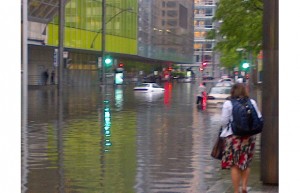
Yesterday’s flash flooding in Montreal caused pipes and sewers to back up, led to water damage in homeowners’ basements, and caused and power outages across the city. Public buildings across downtown were evacuated as they filled with water. The metro’s orange line was down for several hours as several stations flooded. And roadways turned into rivers as our crumbling infrastructure failed to hold up under the water weight.

Photo Credit: Veronique Benhamou. Source: Montreal Gazette.

Flooding at the Palais de Congres. Photo Credit: Veronique Benhamou. Source: Montreal Gazette.

While the flooding did not cause any catastrophic damages in the traditional sense of the word, it did raise chilling echos of the Flood of ’87, and more recently, flooding in 2005. Each time this happens, it only underscores the urgent state of disrepair of our roads, sewers, water mains and infrastructure. But nobody ever seems to do anything about it.

Many homeowners are also discovering the hard way this morning that flood insurance does not exist in Canada. No insurance company offers it; you cannot buy it even if you want to. Extended clauses for water damage specifically exclude flooding. This is something that desperately needs to be changed, through regulation if necessary.

I was lucky; my apartment’s up on the third floor and escaped any damage. I got a bit drenched walking outside in the rain, and an event I attended at a local pub was a bit hindered by the fact that the pub’s kitchen had flooded so they weren’t serving food, but that’s about the extent of it.  A number of my friends were not so lucky, with flooded basements and exploding toilets and drains.

As for the student protesters, I’m thinking they could’ve put their pots and pans to good use: bailing water.

{ 0 comments }

The student tuition protests have dragged on for 14 weeks now and show no sign of ending anytime soon. With the city under siege and anger rising, the media has been flooded with analysis and op-ed pieces of all stripes. But there are some things that nobody’s saying, probably because they’re afraid to rock the boat. That doesn’t make them any less true, though.

[continue reading…]

{ 1 comment }