≡ Menu

The Israeli cabinet voted today in favour of the principle of expelling Yasser Arafat from Israel:

“Recent days’ events have proven again that Yasser Arafat is a complete obstacle to any process of reconciliation … ” the Cabinet’s communique stated Thursday. “Israel will act to remove this obstacle in the manner, at the time, and in the ways that will be decided on separately …”

While Arafat is the worst kind of two-faced terrorist, I happen to think that expelling him is the worst possible move Israel could make right now. I agree with Shimon Peres in this case:

[Peres] warned that expelling Arafat would be a “historic mistake” that would “deepen the hostilities between the Palestinians and ourselves” and told CNN, “Arafat outside will be more effective and more negative than he is today.”

See, the thing is, Arafat has been a thorn in Israel’s side for decades. But there’s no easy solution to the problem. Basically, Israel has three choices: take him out, expel him, or leave him where he is.

Assassinating Arafat would be a pretty stupid move on Israel’s part, since it would turn him into an instant martyr. And that, of course, is exactly what he wants. Arafat’s worst nightmare is to die of old age, of natural causes. It’s been argued that he started the whole intifada because he wanted to go down in history as a martyr, and not as the person who shook hands with an Israeli prime minister. Arafat’s death caused by the IDF would play right into his hands. Not to mention pissing off the few places left in the world with sympathy for Israel.

But expelling him isn’t much better. Right now, he’s confined to his Ramallah compound, essentially under siege, restricted from travel and surrounded by IDF troops. He’s still calling the shots in the PA, which is why Israel is so keen on getting rid of him, but internationally he’s been largely sidelined.

Just look at the propaganda that he manages to create from his compound in Ramallah. Now imagine what would happen if he had the entire world as his base of operations? If he could travel to Syria to arrange weapons imports, and then fly to London or Paris to get his picture on the front page with some opposition politician trying to score far-left brownie points. If he could set up a base of operations wherever he wanted, and whip the Middle East into a frenzy by addressing large crowds or holding court at his whim?

Which is why it’s probably best if Israel just leaves him where he is. The cabinet may think that by removing him from power, it would clear the way for a more moderate Palestinian politician to take the reins. But in all likelihood, it would just strengthen the extremist groups.

So while it’s understandable that Israel would want to kick out Arafat, whose corrupt terorrist-sponsoring leadership has been responsible for the loss of so much innocent life on all sides, strategically it’s not a very smart move.
{ 17 comments }

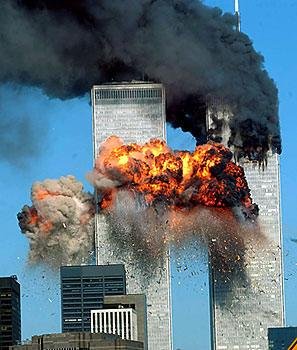
September 11, 2001

twintowers “In a New York Minute, everything can change . . .”

{ 0 comments }

More terrorist attacks in Israel

Those Israelis who were tensely waiting for the next terrorist attack didn’t have to wait long:

At least six people were killed and several others were reported wounded Tuesday, 10 of them seriously, when a suicide bomber blew up just before 6 P.M. at a crowded bus stop adjacent to the Tzrifin military base near Rishon Letzion. Security officials said there were many soldiers at the bus stop.

We can count on the Palestinian Authority – with new puppet Abu Ala – to do what it always does: nothing.

Update: There’s been a second bombing, this one in a cafe in Jerusalem. So far, reports are of at least four killed and dozens more injured in this second blast.

Hamas has claimed “responsibility” for both attacks.

{ 19 comments }

Concordia: One year later

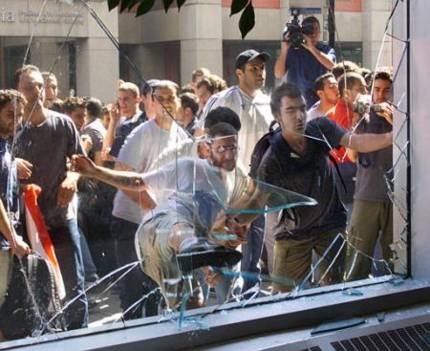
September 9th, 2002:

smashwindows

They came to shut down free speech. They violently rioted, as explained in this widely-circulated eyewitness account. They didn’t want Benjamin Netanyahu to give this speech – or, indeed, to speak at all – and so they gathered to riot, cause mayhem, and rough up people trying to attend.

The fallout made international headlines, led to the blame game almost immediately, and caused a ripple effect that is still being felt.

September 9th, 2003:

They’d have us believe that everything has changed. There’s a new CSU executive, a big orientation party for incoming and returning students, and a lecture series on conflict resolution.

But ultimately, behind the scenes, very little has changed despite surface appearances. Hillel, which had its privileges suspended by last year’s CSU is still fighting to get them restored. The so-called “activists” are still defending the rioting. Benjamin Netanyahu has been invited back to Montreal but not to Concordia. Antisemitism still gets printed in the Link as “legitimate political criticism”. Indeed, there is still much work to be done.

One year later, some baby steps in the right direction have been taken. What happens from here, we’ll just have to wait and see.

{ 5 comments }

WTO in Cancun

I can just hear those anti-globalisation protesters now:

“Yo, dude, it’s awesome! Not only do we get to break stuff and make asses of ourselves . . . but we get to go to Cancun! Party time! (Oh, and capitalism is evil and it’s all a Zionist conspiracy and let’s smash some windows).”

{ 1 comment }

Gilmour hangs up his skates

After 20 seasons as an NHL superstar, Doug Gilmour is calling it quits. He announced his retirement today, citing a knee injury as the catalyst for the decision.

Though he finished his career in Toronto, he spent time in a Habs jersey, and he was always one of the good guys – a team leader. Hockey will miss him.

{ 0 comments }

Around the blogosphere

Damian Penny notes that Global is re-airing the documentary “Confrontation at Concordia” tonight – presumably in recognition of the one-year anniversary of said confrontation. Charles Johnson‘s got the scoop on Abu Ala, the new Palestinian puppet – er – Prime Minister. In the meantime, Gil Shterzer says that Israelis are just waiting for the next Hamas terror attack. Jonathan Edelstein has an Arrival Day 2003 blog summary. Mike Silverman notes that conservatives seem to like affirmative action when it applies to them. And Michele, in the leadup to the two-year anniversary of September 11th, has a moving post on the things that those lost in the attacks were carrying.

{ 0 comments }

Suing the fans

Here’s a great way to get consumers to love ya: Sue them! If you’re the major record labels, apparently this makes perfect sense to you.

{ 0 comments }

Oh the irony!

The United Nations stays quiet through suicide bombing after suicide bombing, and through hundreds of innocent Israelis being murdered. But Kofi Annan feels the need to condemn Israel for targeting the leader of Hamas!

U.N. Secretary-General Kofi Annan condemned Israel’s attempt to kill the spiritual leader of Hamas, accusing the state of using excessive force and violating international humanitarian law, the U.N. spokesman said Monday.

So the U.N. doesn’t mind when innocent kids are killed. But G-d forbid anyone should try to take out a terrorist mastermind!

{ 9 comments }

A comment just below questioned my stance on freedom of speech. I started to reply to it, but realized this is a core issue on this blog and I should address my thoughts to all readers. Some of you will agree and some won’t, but for what it’s worth, here’s how I view this very complex and touchy issue.

Freedom of speech is a precious and inalienable right. David H is correct in saying: “Allowing one group of people to decide that the words of another group are so dangerous that they must be silenced is a dangerous precedent.” I have repeatedly stated that freedom of speech need apply to all, and not only to those we agree with. If I, for example, say that Kevin Spacey is a good actor, and an angry mob of people disagrees with me and decides to riot to prevent me from speaking those words, then they are denying my right to free speech.

But freedom of speech does not imply freedom from the consequences of that speech. And that is where laws about incitement of hatred come into play.

The angry mob that chose to silence the speech of Benjamin Netanyahu was denying the right to freedom of speech by deciding ahead of time that based on who Mr. Netanyahu is – namely, the right-wing, former Prime Minister of a country that they hate – he shouldn’t have the right to address a crowd. That was wrong for many obvious reasons. Having read the text of the speech that Netanyahu planned to give on September 9th of last year, it is clear that – though it contains a political opinion that is unpopular amongst the Left at Concordia, it is far removed from any sort of hate speech. If Netanyahu were to have been permitted to speak, however, and if he did in fact incite hatred, then he would have been subject to the consequences of this under the law, just like anyone else.

I think a great deal of misconception comes from the word “censorship”. The C-word is taken as a given evil, and people scurry away from it screaming. But, to quote the old cliché, freedom of speech doesn’t give you the right to yell “fire” in a crowded movie theatre. Not permitting the yelling of “fire” isn’t censorship; it’s protection of public safety. Similarly, it doesn’t give you the right to approach a contract killer and ask that he murder your wife. That may be speech, but it’s also contracting murder which is – rightly – extremely illegal.

So, of course it is obvious that there are limits to speech. Those are clear-cut cases, but what about cases that aren’t so clear-cut? For example, what about somebody publishing a website denying the Holocaust? This is where societies differ – in the U.S. it’s legal, in Canada it’s not. There are arguments on both sides of the issue here. Some would argue that denying this freedom is ultimately more dangerous, because if the situation were to be reversed and the tyranny became the majority, they could conceivably deny the freedom to you. The true test of freedom of speech, they would argue, is whether we can bear to watch a Ku Klux Klan march, or a neo-Nazi rally, without succumbing to our natural desire to shut these racist assholes up.

I think they make a good point. And that they’re wrong.

Freedoms are not absolute. They end at the point where they interfere with the rights of their fellow human beings. Incitement of hatred has real consequences for the groups against which it is directed. And a society must draw the line somewhere in order to function civilly.

Hate speech is not without cost or consequence. To assume that speech is always peaceful is like saying that contracting a killing is a peaceful, protected act. Certain groups have learned very quickly that if you repeat a lie often enough, people come to believe it as truth. And if you spew hate loudly enough and often enough, you recruit others to your cause, and ultimately create what Ursula Owen calls a “culture of hate“:

In the face of such enormities, the political correctness debate has rather muddied the waters, diluting the wider implications of what hate can produce. For the most dangerous threat behind hate speech is surely that it can go beyond its immediate targets and create a culture of hate, a culture which makes it acceptable, respectable even, to hate on a far wider scale. Such a culture of hate is not easy to define, and does not necessarily have one trajectory, but its evolution is evident in the circumstances surrounding some events in recent history.

[ . . . ]

Words can turn into bullets, hate speech can kill and maim, just as censorship can. So, as dedicated opponents of censorship and proponents of free speech, we are forced to ask: is there a moment where the quantitative consequences of hate speech change qualitatively the arguments about how we must deal with it. And is there no distinction to be made between the words of those whose hate speech is a matter of conviction, however ignorant, deluded or prejudiced, and hate speech as propaganda, the calculated and systematic use of lies to sow fear, hate and violence in a population at large?

Owen has been one of the world’s most staunch supporters of freedom of speech. But even she concedes that the area of hate speech is tricky, and that there are no clear-cut answers.

Speech is a weapon as well as a right. There ought to be a wide range of what is considered acceptable speech. We shouldn’t censor speech simply because we disagree with it or find it distasteful. But when it crosses the line into outright incitement of hatred, then it stops being a healthy part of society and becomes a cancer.

If the majority becomes the tyranny, then hate speech laws may be used against the good minority. But we must prevent the majority from becoming the tyranny in the first place, or else we’ll have a lot more to worry about than laws on freedom of speech. We’ll have lost our humanity.

{ 4 comments }